What Is a Firewall?
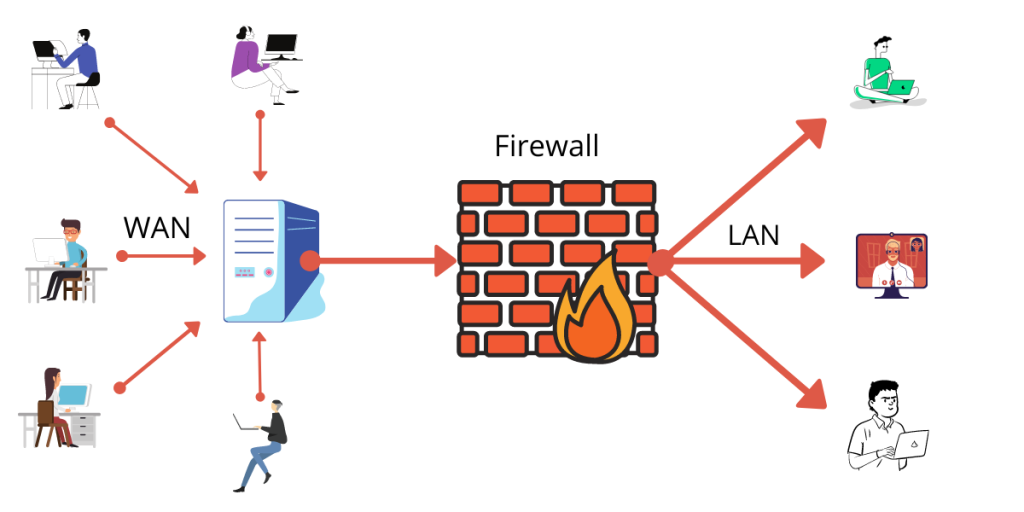
- Definition: A firewall is a security system (hardware or software) that monitors and controls incoming and outgoing network traffic based on predetermined rules.
- Purpose: Acts as a barrier between a trusted internal network and untrusted external networks (like the internet).
- Analogy: Think of it as a security guard at the gate of your network — deciding which data packets are allowed in or out.
Types of Firewalls
- Packet-Filtering Firewall
- Examines packets (basic units of data) and allows/blocks them based on IP addresses, ports, or protocols.
- Simple, fast, but limited (doesn’t inspect content deeply).
- Stateful Inspection Firewall
- Tracks the state of active connections.
- More secure than packet filtering because it understands context (e.g., whether a packet is part of an established session).
- Proxy Firewall (Application-Level Gateway)
- Acts as an intermediary between users and the internet.
- Can inspect traffic at the application layer (e.g., HTTP, FTP).
- Provides deeper filtering but may slow performance.
- Next-Generation Firewall (NGFW)
- Combines traditional firewall features with advanced capabilities:
- Deep packet inspection
- Intrusion prevention
- Application awareness
- Integration with threat intelligence
- Combines traditional firewall features with advanced capabilities:
- Hardware vs Software Firewalls
- Hardware: Physical devices placed between networks (common in enterprises).
- Software: Installed on individual computers/servers (common for personal use).
How Firewalls Work
- Rules: Firewalls use rules (access control lists) to decide whether traffic is allowed or blocked.
- Filtering Criteria:
- Source/destination IP address
- Port number
- Protocol (TCP, UDP, ICMP)
- Application type (web, email, file transfer)
- Actions: Allow, block, or log traffic.
-=||=-FavoriteLike (0)




Must log in before commenting!
Sign In Sign Up