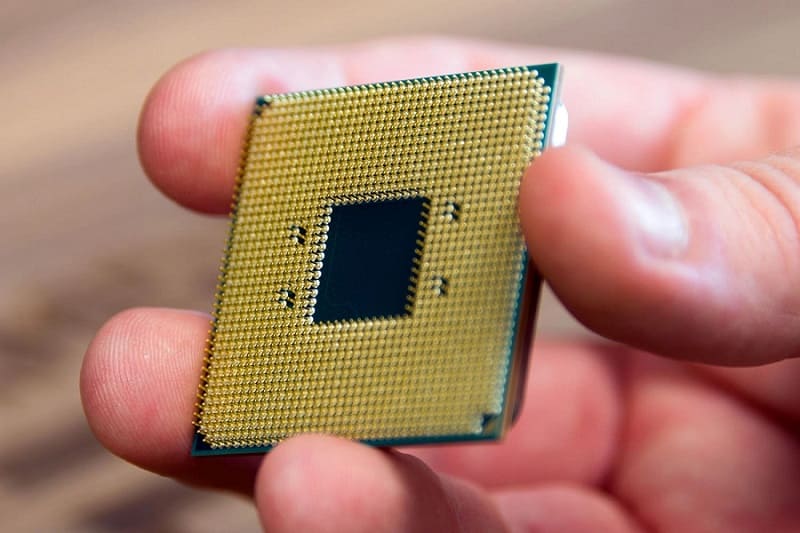
The CPU is often called the “brain of the computer.” It executes instructions from software, processes data, and coordinates tasks across all other components.

Core Functions
- Instruction Execution: Reads and processes commands from programs.
- Arithmetic & Logic: Performs calculations and logical comparisons.
- Control Unit: Directs data flow between memory, storage, and peripherals.
- Registers & Cache: Provides ultra‑fast temporary storage for active tasks.
Key Specifications
- Clock Speed (GHz): Determines how many cycles per second the CPU can execute.
- Cores & Threads: Multiple cores allow parallel processing; threads improve multitasking.
- Cache Levels (L1, L2, L3): On‑chip memory that speeds up data access.
- Instruction Set Architecture (ISA): Defines how software communicates with hardware (e.g., x86, ARM).
Major Players (2025)
- Intel: Core Ultra processors with integrated AI acceleration.
- AMD: Ryzen and EPYC CPUs, strong in gaming and servers.
- Apple: M‑series chips (ARM‑based), optimized for macOS ecosystem.
- Qualcomm: Snapdragon processors for mobile and AI PCs.
- Huawei: Kirin chips for smartphones, focusing on AI and 5G.
| Brand | Key models | ISA | Process node | Segment |
| Intel | Core Ultra 7/9, Core i5/i7/i9 14th Gen; Xeon Scalable (Sapphire Rapids); Xeon 6 | x86-64 | Intel 7, Intel 4, 10 nm class; 7 nm class; 18A roadmap | Desktop, mobile, workstation, server |
| AMD | Ryzen 7000/8000/9000; Ryzen AI; Threadripper 7000; EPYC 9004 (Genoa/Bergamo/Siena) | x86-64 | TSMC N5/N4, N3 (select), 6 nm for IO dies | Desktop, mobile, HEDT, server |
| Apple | M3, M3 Pro/Max; M4 | ARMv9 | TSMC N3/N3E | Laptops, desktops, tablets |
| Qualcomm | Snapdragon X Elite/X Plus; Snapdragon 8 Gen 3/4 | ARMv9 | TSMC N4/N4P; N3 for latest | AI PCs, smartphones |
| MediaTek | Dimensity 9300/9300+; 9400 | ARMv9 | TSMC N4/N3 | Smartphones |
| Samsung | Exynos 2400/2500 | ARMv9 | Samsung 4 nm; 3 nm GAA roadmap | Smartphones |
| Huawei | Kirin 9000S/9010 | ARM-compatible | SMIC ~7 nm class | Smartphones |
| SiFive / RISC‑V | Performance/Intelligence series; Alibaba T‑Head Xuantie | RISC‑V | Various (TSMC 28 nm→N7) | IoT, edge, custom accelerators |
Architecture essentials by brand
Intel
- Core design: Performance (P) cores + Efficiency (E) cores, large L3, advanced branch prediction.
- Key features: AVX‑512 variants (on Xeon), AVX2, Intel Thread Director, integrated NPU on Core Ultra.
- Packaging: EMIB, Foveros 3D stacking in select products.
- Models to know:
- Core Ultra 7/9 (mobile AI PC), Core i9‑14900K (desktop),
- Xeon Scalable (Sapphire Rapids) for HPC/AI, Xeon 6 for efficiency at scale.
AMD
- Core design: Zen 4/Zen 5 with wide front‑end, large ROB, robust cache; SMT for 2 threads per core.
- Key features: AVX‑512 on Zen 4, Ryzen AI NPUs, strong memory controllers (DDR5), PCIe Gen5.
- Packaging: Chiplet architecture (CCD + IOD), 3D V‑Cache on X3D parts.
- Models to know:
- Ryzen 7 7800X3D (gaming), Ryzen 9 7950X/8950X (desktop),
- Threadripper 7970X/7995WX (HEDT/workstation),
- EPYC 9004 Genoa/Bergamo (server density and HPC).
Apple
- Core design: High IPC performance cores + efficiency cores; unified memory architecture (UMA).
- Key features: Powerful GPU blocks, Neural Engine, media engines; tight hardware–software integration.
- Models to know: M3/M3 Pro/M3 Max (TSMC N3), M4 (latest iPad, higher efficiency and AI).
Qualcomm
- Core design: Oryon custom ARM cores (X Elite), big‑little configurations on mobile.
- Key features: On‑die NPUs, advanced ISP, integrated 5G; strong AI PC push.
- Models to know: Snapdragon X Elite/X Plus (Windows on ARM laptops), Snapdragon 8 Gen 3/4 (flagship phones).
MediaTek
- Core design: All‑big core strategy on Dimensity 9300; advanced GPU and AI cores.
- Key features: Efficient AI accelerators, fast modem, competitive graphics.
- Models to know: Dimensity 9300/9300+, next‑gen 9400.
Samsung
- Core design: ARM Cortex X/Prime/Efficiency cores; AMD GPU collaboration on mobile.
- Key features: Integrated NPUs, advanced camera pipelines.
- Models to know: Exynos 2400/2500.
Huawei
- Core design: ARM‑compatible cores with in‑house design; emphasis on power efficiency.
- Key features: Integrated 5G (regional variations), NPUs for on‑device AI.
- Models to know: Kirin 9000S/9010.
RISC‑V ecosystem
- Core design: Modular ISA with extensible vectors; customizable cores for domain‑specific needs.
- Use cases: IoT, edge AI, microcontrollers, accelerators; growing interest in Linux‑capable cores.
Instruction sets and extensions
- x86‑64 (Intel/AMD): Mature ecosystem; AVX/AVX2/AVX‑512, AES‑NI, SHA, virtualization (VT‑x/AMD‑V).
- ARMv8/ARMv9: NEON, SVE/SVE2 (vectors), crypto extensions; TrustZone for secure execution.
- RISC‑V: RV64/32 base with modular extensions; RVV (vector), Zk (crypto), hypervisor extensions.
Process nodes and manufacturing
- TSMC: N7→N5→N4→N3/N3E; leading density and efficiency used by AMD, Apple, Qualcomm, MediaTek.
- Intel: Intel 7, Intel 4; roadmap to 20A/18A with RibbonFET (GAAFET) and PowerVia.
- Samsung Foundry: 5 nm/4 nm EUV; pushing 3 nm GAA.
- SMIC: ~7 nm class advancements; domestic ecosystem support.
Packaging and memory
- Chiplets: AMD CCD/IOD; improves scalability and yields.
- 3D stacking: Intel Foveros; AMD 3D V‑Cache for gaming/HPC.
- HBM integration: Primarily on GPUs/accelerators; appearing on CPU‑adjacent AI chips.
- Interconnects: PCIe Gen4/Gen5/Gen6, CXL for coherent memory expansion on servers.
How to choose a cpu (by use case)
- Gaming desktop:
- AMD Ryzen 7 7800X3D or Ryzen 9 X3D for cache‑sensitive titles.
- Intel Core i7/i9 14th Gen for high clocks and mixed workloads.
- AI PC/mobile productivity:
- Intel Core Ultra or AMD Ryzen AI with NPUs;
- Snapdragon X Elite if you prioritize battery life and on‑device AI on Windows on ARM.
- Workstation/HEDT:
- Threadripper PRO 79xx WX or Intel Xeon W for multi‑core rendering, CAD, and simulation.
- Servers:
- EPYC 9004 (Bergamo/Genoa) for density and memory bandwidth;
- Xeon Scalable for ecosystem features and accelerators.
-=||=-FavoriteLike (0)


Must log in before commenting!
Sign In Sign Up