Engines of Extreme Computation
A supercomputer is a high performance computing system designed to execute complex calculations at speeds far beyond those of conventional computers. Measured in floating point operations per second (FLOPS), supercomputers today operate in the petaflop (10^15) and exaflop (10^18) ranges, enabling breakthroughs in science, engineering, and artificial intelligence. They represent the pinnacle of computational technology, combining massive parallelism, specialized architectures, and advanced cooling systems.
Historical Development
- 1960s: The CDC 6600, designed by Seymour Cray, is widely regarded as the first true supercomputer.
- 1970s–1980s: Vector processing became dominant, with Cray Research producing iconic machines such as the Cray‑1.
- 1990s: The rise of massively parallel processing (MPP) architectures shifted focus from single powerful processors to thousands of interconnected nodes.
- 2000s–2010s: GPU acceleration and heterogeneous computing architectures transformed performance, allowing supercomputers to handle AI workloads.
- 2020s: The race toward exascale computing began, with nations investing heavily in next‑generation systems.
Architecture and Design
- Processors: Supercomputers employ diverse processor types, including RISC CPUs, vector processors, GPUs, and custom accelerators.
- Interconnect Networks: High‑speed communication is achieved through topologies such as fat‑tree, torus, or dragonfly, often using InfiniBand or proprietary interconnects.
- Operating Systems: Most run specialized Linux distributions optimized for parallel workloads.
- Programming Models: Frameworks like MPI (Message Passing Interface) and OpenMP enable efficient parallel programming.
- Storage Systems: Distributed file systems such as Lustre or GPFS provide high‑throughput access to massive datasets.
- Cooling and Energy: With power consumption rivaling small cities, advanced cooling methods — liquid immersion, chilled water, or hybrid systems — are essential.
Applications
Supercomputers are deployed in diverse fields where extreme computational power is required:
- Scientific Research: Simulating astrophysical phenomena, modeling quantum mechanics, and decoding genetic sequences.
- Engineering and Industry: Aerospace firms use supercomputers for aerodynamic modeling, while automotive companies simulate crash tests virtually.
- Medicine and Drug Discovery: Molecular dynamics simulations accelerate the identification of potential pharmaceuticals.
- Artificial Intelligence: Training large-scale deep learning models requires GPU-accelerated supercomputing clusters.
- National Security: Nuclear test simulations and cryptographic analysis are conducted on secure supercomputing platforms.
- Financial Modeling: Supercomputers analyze global markets, run risk simulations, and optimize investment strategies for large institutions.
Global Rankings
Supercomputers are ranked on the TOP500 list, updated twice annually, based on the LINPACK benchmark. The Green500 list highlights energy efficiency. Notable systems include:
- Summit (USA): Once the fastest, used for energy research and AI.
- Sunway TaihuLight (China): A milestone in indigenous processor design.
- Frontier (USA): The first officially recognized exascale supercomputer, surpassing one quintillion FLOPS.
Future Trends
- Exascale Computing: Systems capable of 10^18 operations per second will enable unprecedented simulations in physics, medicine, and defense.
- Heterogeneous Architectures: Combining CPUs, GPUs, and specialized accelerators (e.g., TPUs) to optimize workloads.
- Green Computing: Energy efficiency is becoming a critical metric, driving innovation in cooling and power management.
- Quantum Integration: Hybrid architectures may merge classical supercomputers with quantum processors, opening new frontiers in cryptography and optimization.
- Global Competition: The United States, China, and the European Union continue to invest strategically in supercomputing as a matter of technological leadership and national security.
Real-World Example
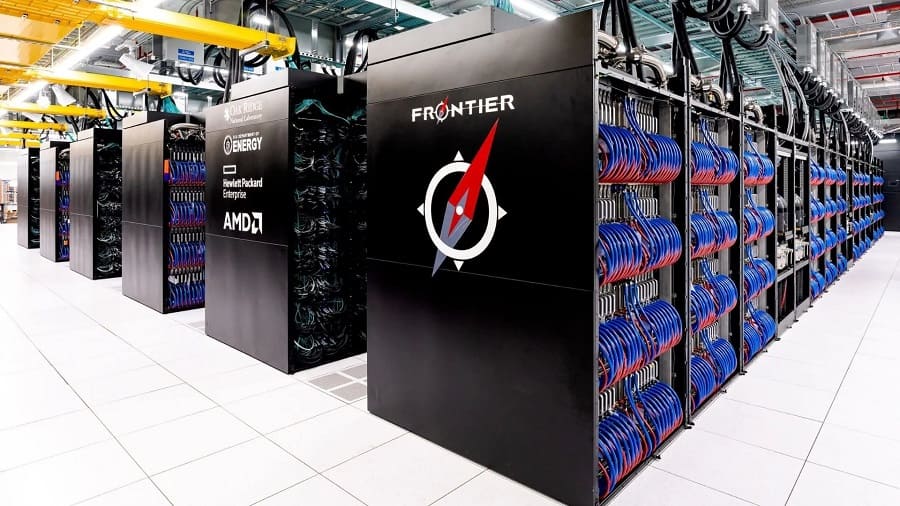
- Deployment: Became operational in 2022 at the Oak Ridge Leadership Computing Facility.
- Performance: Achieved 1.353 exaFLOPS (Rmax) and a theoretical peak of 2.055 exaFLOPS (Rpeak) — that’s over one quintillion floating‑point operations per second.
- Compute Nodes:
- 9,856 AMD compute nodes in total.
- Each node has 1× 64‑core AMD EPYC CPU (3rd Gen, optimized for HPC) with 2 hardware threads per core.
- Each node also contains 4× AMD MI250X GPUs, each with 2 Graphics Compute Dies (GCDs). That’s 8 GPU dies per node, each with 64 GB of high‑bandwidth memory.
- Memory per node: 512 GB DDR4 system memory.
- System Cabinets: 77 HPE Cray EX “Olympus” racks, each with 128 compute nodes.
- Operating System: HPE Cray OS.
- Power Consumption: Around 24.6 megawatts, comparable to the electricity usage of a small city.
- Physical Size: Occupies about 680 m² (7,300 sq ft) of floor space.
- Cost: Estimated at US$600 million.
- Purpose: Scientific research in energy, materials science, medicine, and national security.
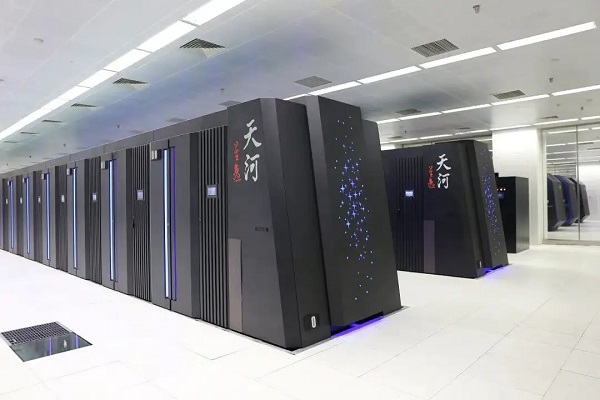
| Parameter | Details |
|---|---|
| Location | National Supercomputer Center, Guangzhou, China |
| Architecture | 32,000 Intel Xeon E5‑2692 (12 cores, 2.2 GHz) + 48,000 Intel Xeon Phi 31S1P coprocessors |
| Total Cores | ~3,120,000 cores across 16,000 nodes |
| Performance | 33.86 petaflops (Linpack benchmark); theoretical peak ~54.9 petaflops |
| Memory | 1,375 TB (1,000 TB CPU + 375 TB coprocessor) |
| Storage | 12.4 PB |
| Operating System | Kylin Linux |
| Power Consumption | 17.6 MW (24 MW including cooling) |
| Cost | ~2.4 billion Yuan (~US$390 million) |
| Applications | Large‑scale simulations, scientific analysis, government security research |



Must log in before commenting!
Sign In Sign Up